
Photo Gallery

|
Accedia AI Fraud Detector
Additional Info
| Company | Accedia |
| Company size | 201-500 employees |
| World region | Europe |
| Website | https://accedia.com/ |
NOMINATION HIGHLIGHTS
The Accedia AI Fraud Detector is a machine learning solution that replaces static, rule-based fraud systems with probability-based risk scoring. It scores every transaction alert, explains every decision in language auditors can follow, and routes only the real threats to analysts. It is built for fraud operations leaders at banks, fintech and payment processors who need to catch fraud, cut the noise and defend every decision to a regulator.
Rule-based fraud systems trap banks in an impossible trade-off. Tighten the rules and analysts drown in false alerts while legitimate customers get declined. Loosen them and real fraud slips through. Regulators now add a third demand: explain every automated decision. Attackers are already using generative AI: Deloitte projects it could push US fraud losses to $40 billion by 2027.
The detector removes this trade-off in four steps. First, it gives every transaction alert a fraud probability from 0 to 1, drawing on multiple behavioral and contextual factors. Second, it places each transaction in a Low, Medium or High risk category, based on thresholds the institution sets to match its own risk tolerance. Then it attaches weighted reason codes to every score, showing which factors drove the decision and by how much. Finally, it routes each case automatically: low-risk alerts are approved, high-risk alerts escalate immediately, and analysts spend their time only on the cases that need human judgement. A real-time dashboard shows workload, exposure, accuracy and fraud distribution.
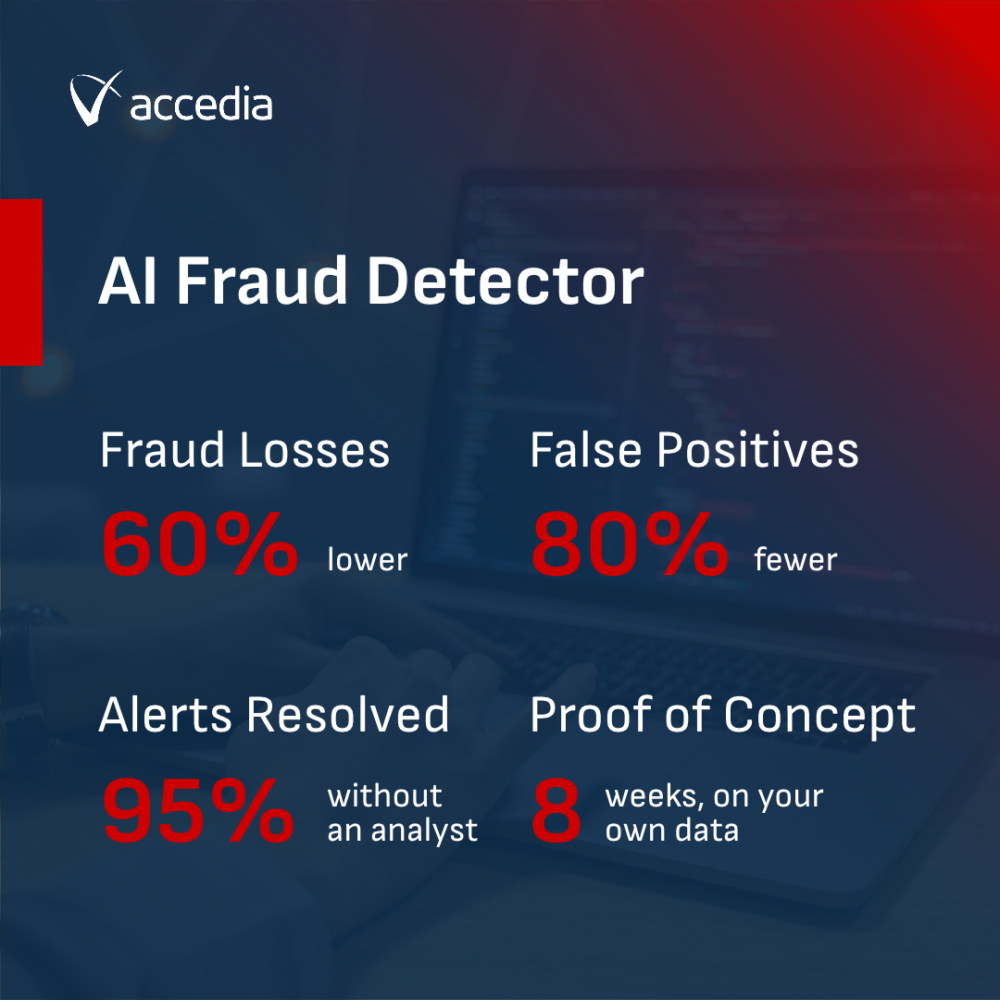
Many AI fraud tools ask banks to trust a black box: this detector shows the reasoning behind every decision. Each score comes with an audit trail written for people who are not data scientists. This supports DORA requirements for anomaly detection and incident classification, as well as FCA expectations on explaining AI decisions. Control stays with the institution, whose own team decides what triggers auto-approval, manual review or auto-decline. So does the data: the detector runs inside the institution’s own infrastructure and connects to its existing fraud platform through a REST API, in real time or in batch. A working proof of concept runs on the institution’s own data within 8 weeks of kickoff. The whole solution is built under ISO 27001-certified security practices by a fully in-house team.
The results are measurable. Tested on the public IEEE-CIS fraud detection benchmark of 590,540 real e-commerce transactions, the detector reduced fraud losses by 60%. It cut false positives by 80% and resolved 95% of clear-cut alerts automatically, without involving analysts. We chose a public benchmark on purpose, because production results depend on each institution’s data and threshold settings. That is the reason why every engagement starts with a proof of concept on the client’s own transactions.
For a fraud team, this means fewer good customers blocked by mistake, more analyst hours spent on real threats, and AI decisions the compliance function can sign off with confidence.
Help This Nominee Win a
Community Choice Award
Vote by sharing this page:
Cast your vote by sharing this nominee’s profile on LinkedIn, Facebook, or X, using the buttons above. Each completed social share adds one Community Choice vote.
Votes cast by July 10, 2027 will determine the Community Choice winners (independent of the jury awards). Winners will be announced before Black Hat USA.
What is the Community Choice Award? →
Community Choice is a separate award track from the jury-selected Cybersecurity Excellence Awards. Jury winners are chosen by expert judges, while Community Choice winners are determined by public voting. A nominee may be honored by the jury, the community, or both.